Green Power Revolution
Installation confirmed.
Skylar Solar — Installation Confirmed
£16,950.32 all-in. Install 5–6 August 2026. Scaffolding up 3rd, down 10th. Full payment on completion, no deposit.
19 × AIKO 495W panels (9.41kWp) · Sigenergy 12kW hybrid inverter · 9kWh battery · DC EV charger 12kW · MCS cert · 25-year workmanship warranty · 10-year HIES insurance.
The two phases
Installation countdown
Action items
- Skylar Solar quote accepted — £16,950.32 all-in. Post-survey final.
- Finance secured — £20,000 interest-free cash
- Post-survey completed — panel layout confirmed (19 panels, 3 groups)
- DNO application submitted by Skylar
- Notify home insurer — solar install, confirm panels covered for accidental damage
- Switch to Octopus — when Fuse contract expires October 2026
- Register for SEG with Octopus on install day
The Plan
Two phases. Solar first, EV when the time is right.
Solar, Battery & EV Charger
- Skylar Solar quote accepted — £16,950.32 all-in
- Finance secured — £20,000 interest-free cash
- Post-survey completed — panel layout and system design confirmed
- DNO application submitted by Skylar (in their hands)
- Scaffolding up — 3 August 2026
- 2-day install: 19 × AIKO 495W panels, Sigenergy 12kW inverter, 9kWh battery, DC EV charger
- Scaffolding down — 10 August 2026
- Switch to Octopus — when Fuse contract expires October 2026
- Register for SEG with Octopus on install day
EV Purchase
- EV charger (Sigenergy DC 12kW, V2H-capable) installed in Phase 1 — ready and waiting
- Vehicle choice and financing not yet decided
- Must have V2H capability — the EV battery becomes our second home battery
- A 40–60kWh EV battery dwarfs a second 10kWh home unit
Action items now
- EPC rating confirmed — B (valid to Nov 2027)
- Skylar Solar quote accepted — £16,950.32 all-in. Post-survey final.
- Finance secured: £20,000 interest-free cash. Covers the install with ~£3k to spare.
- Post-survey completed. Panel layout confirmed.
- Notify home insurer — solar install, confirm panels are covered for accidental damage
- Prepare for scaffolding — 3 August 2026
- Switch to Octopus when Fuse contract expires (October 2026)
V2H — the EV as a second battery
Instead of buying a second home battery (~£3,500–4,500), the plan is to buy an EV with Vehicle-to-Home (V2H) capability. The Sigen DC charger is already bi-directional and V2H-ready.
- Massive capacity. A typical EV battery is 40–60kWh — that's 4–6× bigger than a second home battery. Even using just 20kWh of the EV battery to power the house covers an entire day.
- Already paid for. You're buying the EV anyway for transport. The V2H capability comes free with a compatible vehicle.
- Better arbitrage. Charge the EV overnight at ~5p/kWh, discharge into the house during peak rates. Same principle as battery arbitrage but with far more capacity.
The EV must have V2H/V2G capability. Not all EVs support this yet — it's a key factor in the vehicle decision.
Post-survey — everything confirmed
- Quote accepted — £16,950.32 all-in
- Finance secured — £20,000 interest-free cash
- Post-survey complete — system design finalised
- DNO application in Skylar's hands
- Notify home insurer of solar install
Solar & Battery Installation
- 3 Aug: Scaffolding up
- 5–6 Aug: 2-day install — 19 × AIKO panels, inverter, 9kWh battery, DC EV charger
- 10 Aug: Scaffolding down
- Register for SEG with Octopus on install day
Switch to Octopus
- Fuse Energy contract ends — switch to Octopus, no exit fees
- Move onto Octopus Flux if available (battery arbitrage unlocked)
- If Flux not available: Cosy Octopus + Outgoing Octopus as fallback
First full solar season
Everything installed, Octopus running, battery arbitrage optimised. April–September 2027 is when you see the full system working — near-zero electricity bills, surplus generation exported for income.
EV Purchase
- DC charger installed in Phase 1 — V2H-ready and waiting
- Vehicle and financing to be decided
- Must have V2H capability — acts as second home battery
The Money
Every number, laid out honestly.
Monthly outgoings: before vs after
Solar savings only — no heat pump, no EV yet. Petrol and gas unchanged.
Where the £16,950 goes
System cost breakdown
| Item | Cost |
|---|---|
| 19 × AIKO Neostar 3S A495-MCE54Mb panels (9.41kWp) | |
| Sigenergy 12.0 SP hybrid inverter (12kW) — 10-year warranty | |
| SigenStor BAT 10.0 battery (9kWh usable) | |
| Sigen EV DC Charging Module 12kW with 5m CCS2 cable — 3-year warranty | |
| Installation — in-house teams (roofing specialists + electricians) | |
| MCS certificate | |
| 25-year workmanship warranty | |
| 10-year HIES insurance-backed warranty | |
| Scaffolding | |
| Bird protection (bird guard) | |
| Total (0% VAT) | £16,950.32 |
All-inclusive package from Skylar Solar — UK's only Sigenergy Platinum Partner. In-house fitters only, no subcontracting. Full payment on completion, no deposit. Quote dated 17 April 2026, post-survey revision 2 June 2026.
Estimated savings (Skylar MCS calculation)
| Energy generated per year | 7,703 kWh |
| Electricity savings per year | ~£1,505 |
| CO₂ reduction per year | 4,865 kg |
| Payback period | ~8 years 9 months* |
*Skylar's payback estimate assumes rising energy prices. At current prices, payback is ~11 years on energy savings alone. With house value uplift, the system is in profit from day one on paper.
The funding
Payback over time (energy savings vs investment)
Conservative estimate at today's energy prices (~£1,504/year). The £25k house value uplift means the system is effectively in profit from day one on paper.
The Case
Why we're doing this. The numbers, the logic, the system.
The core logic
Right now, ~£184 a month leaves our account on energy and we get nothing back for it. After solar, a big chunk of that electricity bill disappears — we generate more than we use for half the year.
The system pays for itself in under 9 years (Skylar's estimate), and immediately adds £25k+ to the house value. We're not spending more — we're redirecting what we already spend.
After the upgrade
- Near-zero electricity bills May–September
- Battery charged overnight at ~5p, used at peak rate
- ~£20/month income from grid export (SEG)
- EV charger ready — charge at home when we get an EV
- V2H-ready — future EV acts as a massive second battery
- Protected against future electricity price rises
What's being installed
- 9.41kWp solar array — 19 × AIKO Neostar 3S 495W panels
- SigenStor BAT 10.0 (9kWh usable) — runs the house 10–15 hours
- Sigenergy 12.0 SP hybrid inverter (12kW)
- Sigen DC EV charger 12kW — V2H-capable, installed now for future EV
- Bird protection, scaffolding, MCS cert, 25yr warranty, 10yr HIES
Why act now
- 0% VAT on solar & battery — expires March 2027
- Energy prices projected to keep rising
- Where we live: top 10% UK for sunshine hours
- System generates 7,703 kWh vs 4,500 kWh used — massive surplus
- House value uplift: +£25–50k estimated
Panel layout — roof design
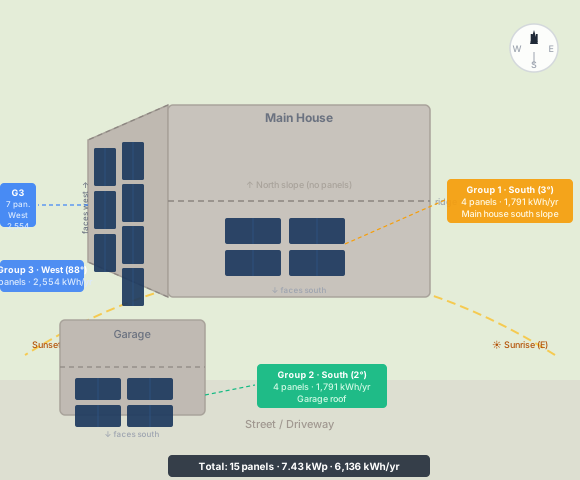
19 panels across 3 groups. Groups 1 & 2 on the main house near-south; Group 3 on the west-facing roof (generates into the afternoon/evening). 9 panels near-south, 10 panels west-facing.
| Group | Panels | Orientation | Pitch | Annual output |
|---|---|---|---|---|
| Group 1 | 5 | 3° from south | 45° | 2,279 kWh |
| Group 2 | 4 | 2° from south | 35° | 1,827 kWh |
| Group 3 | 10 | 88° from south (west) | 45° | 3,597 kWh |
| Total | 19 | 7,703 kWh |
Monthly solar generation (kWh)
9.41kWp system. Total ~7,703 kWh/year (MCS-certified by Skylar).
Generation vs consumption
May–September: self-sufficient. Winter: grid top-up at cheap overnight rates.
How the system works
Surplus follows this priority order automatically. The Sigenergy inverter manages everything.
Energy tariff — Fuse now, Octopus from October
| Fuse (current — expires Oct 2026) | Octopus Flux (target) | |
|---|---|---|
| SEG export rate | ~13p/kWh | 27–29p/kWh peak (16:00–19:00) |
| Overnight cheap rate | No | ~4.2–5.2p/kWh (02:00–05:00) |
| Battery arbitrage | No | Yes — charge cheap, export at peak |
| Annual export income (est.) | ~£205 | ~£430+ (at peak rate) |
Fuse Energy contract runs until October 2026. Switch to Octopus then — no exit fees. Note: Octopus Flux availability is uncertain — if not available, Cosy Octopus + Outgoing Octopus is the strong fallback.
Our home — EPC snapshot
At 72 kWh/m², our home uses roughly half the UK average. Well-insulated and efficient — ideal for solar.
CO₂ footprint — before and after
We're already at less than a third of the UK average. Solar takes us close to zero on electricity — gas remains until/unless we add a heat pump later.
Power cuts — what to expect
UK law requires grid-tied inverters to shut down when the grid fails. Without a backup gateway, a power cut means no power even with a full battery — the system shuts down like everyone else's.
The Sigenergy Gateway would fix this. We've chosen not to include it to keep costs down. It can be added later.
Ongoing maintenance
| Solar panel cleaning (optional, every 1–2 years) | £100–150 |
| Inverter health check | £50–100 |
| Inverter replacement (~year 12–15) | £1,500–2,000 |
| Battery replacement (~year 12–15) | £3,000–5,000 |
The honest verdict
Phase 1 is a solid financial decision — funded interest-free, backed by 0% VAT, and with a clear payback. It's an inflation hedge, a bill reducer, and a property investment. The system generates 70% more electricity than we use.
Phase 2 (the EV) is still being worked out. The charger is going in now and it's V2H-capable, so there's no rush — the car decision can be made on its own terms when the time is right. And when it comes, the EV battery becomes our second home battery too.
Notes & Questions
Save anything worth remembering, or raise a question.
Notes
Questions & Concerns
Ask Claude
Ask anything about the plan. Claude has full context on the numbers and the tech.